

4.9 out of 5 49,266 reviews

Mon to Fri: | Sat:

kWh and kW Explained

By David Lewis, Electric Vehicle & Clean Energy Journalist.

Have you come across the confusing jargon of kWh and kW when reading about electric cars? Wondering what they mean? Read our easy to understand guide to these perplexing terms.

kWh Meaning

Let’s start with the easier one: kWh.

kWh stands for ‘kilowatt-hour’. And what is a kilowatt-hour? It’s a unit of electricity. So 1 kWh = 1 unit of electricity.

Your house has an electricity meter. It records how much electricity you use.

You know that number on the meter that keeps going up? The number tells you the kilowatt-hours (kWh) – or units of electricity – you have consumed.

What Has kWh Got To Do With Electric Cars?

An all-electric car has a battery which powers an electric motor (or motors) which in turn makes the wheels go round.

That car battery stores units of electricity. It stores kWh.

Let’s consider the Renault Scenic E-Tech. It has a battery with a usable capacity of 87 kWh. What does that mean? When fully charged, the Scenic can store 87 units of electricity.

As you drive the car, you use up electricity from the battery. It will go down from 87 kWh to 86, 85, 84, and so on.

Note: EVs are often quoted with two different battery capacities in kWh: 'nominal' or 'gross' battery size, and 'net' or 'usable' battery size.

It's the usable battery capacity that counts; that's the number of kWh that your battery can actually store and use.

Renault Scenic E-Tech Example

Imagine you leave home in your electric Renault Scenic on a full battery and then return at the end of the day having consumed 15 kWh of electricity.

That equates to roughly 54 miles of driving, assuming an efficiency of 3.6 miles per kWh. The battery will now have 72 kWh remaining in it (87 kWh minus 15 kWh). You plug the car in, and – as you are on an off-peak, smart tariff – the car delays the charging process until the cheaper charging window begins, typically at night.

When the car does start charging, it takes just a couple of hours to charge the battery back up to 87 kWh. That’s 1 kWh of electricity back into your Scenic's battery every 8 minutes, approximately.

kW Meaning

OK, now for the harder definition of kW, which is short for 'kilowatt'.

What’s a kilowatt? It’s a measure of how much electrical power a device needs to operate.

Think of a kettle. Many kettles are rated at 2 kW. That means the kettle needs 2 kW of power to boil your water.

Power, or kW, is like a flow of electricity from the socket, down the cable, into the kettle itself.

Note: There's also a smaller unit of power, namely a 'watt' or W.

If an electronic device needs 1,000 watts, you can also describe it as 1 kW. So the 'kilo' part of the word means 1,000.

How Does kW Relate To Electric Cars?

If you get a dedicated charging point installed at home, it will most likely have a power rating of 7.4 kW.

A lot more electricity can flow through your 7.4 kW charging point at any given moment than can flow into the 2 kW kettle.

The charging point can handle 3.7 times more electricity (7.4 kW divided by 2 kW).

A Water Hose – Really?!

It’s like having a larger diameter water hose – you can get a higher volume of water through it every second.

In this case, we are talking about a 'higher volume' of electricity flowing when you have a higher kW rating.

How is the car's on-board limit relevant?

So the Renault Scenic E-Tech plugged into a 7.4 kW home charger has its battery charged at the same rate as the charger itself: 7.4 kW.

The electricity flows from your charger on the wall, down the charging cable, into the car, without restriction.

Note: there are still some electric cars that have an on-board charging limit lower than 7.4 kW for home (AC) charging.

For example, the Dacia Spring can only charge at a maximum rate of 6.6 kW (AC), even if it's plugged into a 7.4 kW charger.

This is due to technology inside the car itself – nothing to do with the charger on your wall.

Questions?

Why not phone us now on 0118 3048 688 and speak to one of our friendly EV leasing consultants, or email us at enquiries@selectcarleasing.co.uk

Just to confuse the issue a little…

kW and BHP

The power of traditional petrol and diesel car engines is measured in ‘BHP’ or ‘Brake Horse Power’, or sometimes just 'HP'.

The metric equivalent of BHP is – you guessed it – kW.

So you will see either BHP or kW, or both, when you read about how powerful a car’s international combustion engine or electric motor(s) are. 

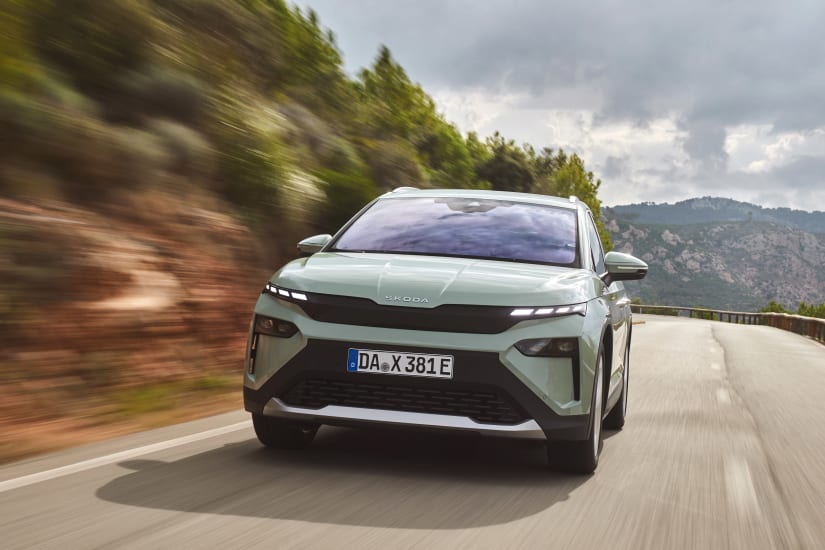
For example, the Skoda Elroq (125 kW 50 SE 55 kWh 5dr Auto 2026) has an electric motor power rating of 170 BHP or 125 kW.

kWh and kW – Maths Test!

Have you been paying attention so far? Prove it! Here’s your question:

“How many units of electricity, or kWh, can you get into the Renault Scenic E-Tech’s battery after 3 hours of charging on a 7.4 kW charging point?”

We know, it’s like GCSE Maths all over again.

Actually it’s fairly logical:

A 7.4 kW charger charging for 1 hour delivers 7.4 kWh of electricity to the car. Here’s the maths: 7.4 kW x 1 hour = 7.4 kWh. Easy! 

So, 3 hours of charging the Scenic puts roughly another 22 kWh of electricity back into the battery (7.4 kW x 3 hours = 22.2 kWh).

What About The kW Rating Of Rapid Chargers?

It's August, and you’re on a trip from Plymouth to Edinburgh to see the Edinburgh Festival Fringe. Distance door-to-door: 488 miles.

Your all-electric Volvo EX60 (P6 275 kW 83 kWh Plus 5dr Auto 2027) has a maximum battery range of 385 miles, so you can’t get all the way to Edinburgh on one charge of the battery.

You stop at a motorway service station after 300 miles to top up your battery.

The kind of chargers you find at service stations are known as ‘rapid’, 'ultra-rapid' or 'DC' chargers.

They can get electricity into your car much more quickly than a home (AC) charging point.

Rapid charger ratings typically vary from 50 kW to 350 kW+.

Let’s imagine this motorway rapid charger is rated at 150 kW.

Your Volvo EX60 has a blazingly fast maximum on-board rapid DC charging rate of 320 kW, so you can easily take the full 150 kW from the charging point without any power limitations.

You’re in a rush to get to the festival and only want to stop and charge for 20 minutes. Charging at 150 kW will add roughly 50 kWh in that time, the equivalent of about 210 miles of range (assuming Volvo's official efficiency rating for the car of 4.2 miles per kWh). 20 minutes later, you're on your way again to Edinburgh.

Note: electric cars don't always charge at a constant speed. Especially on rapid chargers, you'll notice the charge rate decreases while it's charging. This is to protect the battery cells from over-heating. The upshot? Charging often takes longer than you think and the timings above are therefore estimates.

At A Glance Summary

If your mind is well and truly scrambled after reading this guide, here's a convenient summary:

  • The term ‘kWh’, or ‘kilowatt-hour’, signifies a ‘unit of electricity’.
  • Electric car batteries store units of electricity, or kWh, and as you drive they get used up.
  • The term ‘kW’, or ‘kilowatt’, refers to the power rating of charging points. 7.4 kW is normal for a home charger. Public chargers vary from 50 kW to 350 kW+.
  • kW is also the metric equivalent of BHP or brake horse power, basically how powerful the engine or electric motor(s) are.

All About Electric Vehicles

Check out our dedicated EV zone for all things electric

Learn more

New to Car Leasing?

Discover the many advantages of leasing a vehicle

Learn more

Business & Fleet?

Comprehensive fleet management solutions for your business

Learn more