

Smart #3 (2025) Review
Introduction
Smart’s transition from city car creators to premium electric vehicle proponents is more or less complete, with the #1 and #5 receiving solid reviews. But the #3 is a slightly tougher sell, with its coupe-esque shape and rounded, friendly design cues that make it something of a niche within a niche. Nevertheless, Mercedes-Benz-backed Smart is bullish about the car’s prospects, and hopes it can compete with the best in its class.
It’s a tough job for any car, with rivals from the likes of Volvo, Kia and Genesis all in the mix, along with other big names such as Lexus and Alfa Romeo. But Smart reckons it can compete, and the evidence of the #1 and #5 suggests there are good reasons for that. The #1 shows great promise, and the #5 is a really strong electric SUV, so it stands to reason that the #3 will have many of the same qualities. But is that how things pan out, or will the Smart feel like a bit-part or an oddball in such elevated company?
Select's rating score* - 3.4 / 5
At a Glance
The #3 is arguably the most style-orientated of Smart’s current-generation models, with its curvy shape and SUV stance, but that doesn’t mean it isn’t practical as well. The well-made, stylish interior is roomy and airy, while there’s plenty of technology in the cabin. Admittedly, boot space isn’t quite so impressive, and the technology feels a bit too complicated to be truly user-friendly, but the materials and the build quality ensure it still feels premium.
Under the skin, the #3 gets a choice of battery sizes and power outputs, and you can choose whether you want a single-motor, rear-wheel-drive example or a twin-motor, all-wheel-drive model. All manage more than 200 miles on a charge, according to the official economy test, and they’re all pretty quick. Even the base model will get from 0-62mph in 5.8 seconds.
On the road, the #3 is enjoyable to drive, if not especially engaging. The steering is a bit numb and the pedal feel isn’t great, but the body control is pretty good and there’s plenty of grip, which makes it feel stable and secure, without being especially engaging. More impressive, though, is the smooth ride that’s present across the range, and makes the #3 really relaxing on a long motorway drive. Even if motorway speeds don’t do the range many favours.

Key Features
The #3’s appeal comes primarily from its styling, which manages to merge the customisable and premium with minimalism and futuristic design, both inside and out. It’s almost like Mini in its ability to be fresh and cool, while still feeling upmarket. Admittedly, the #3 won’t be for everyone – that curvy coupe-SUV look isn’t suited to all tastes – but it certainly has its charms. And there’s no doubt it looks at home alongside other fresh-faced premium electric vehicles.
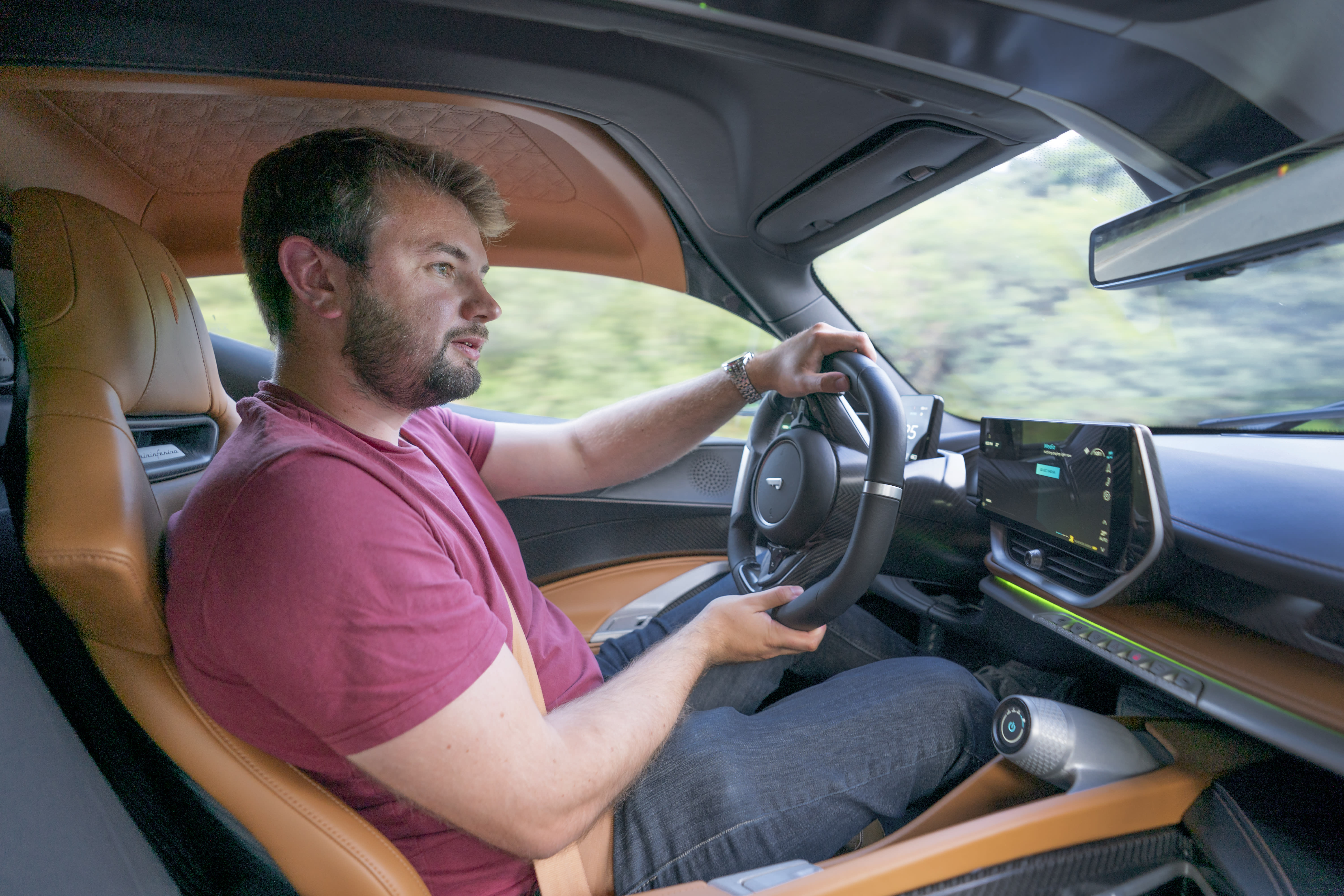
That style continues inside, with a modern look that’s focussed on technology, with big screens and little in the way of conventional switchgear. The ergonomics aren’t always perfect – the buttons on the steering wheel can be a bit confusing and the touchscreen is a bit awkward at times – but it looks great, especially with the cool seat designs and the contrast stitching options. Brown and black leather with yellow stitching doesn’t sound great, but it works quite nicely in the cabin, especially with the silver dashboard and door trim.
But there’s substance behind the style, with plenty of range, excellent build quality and impressive ride comfort, so the #3 has plenty of merits beyond its design. It’s a comfortable cruiser, and surprisingly capable over a long drive.

Range & Batteries
The #3 essentially offers customers a choice of two different battery sizes. Base models, which are still quite well equipped, get the 49kWh power pack that is, officially speaking, good for 202 miles between trips to the plug. That isn’t bad, but given real-world range will be noticeably lower, particularly if you drive on the motorway, that probably won’t be the #3 of choice for those regularly doing long journeys.
Upgrade to the 66kWh battery, however, and the #3’s long-range capabilities improve dramatically. With that power pack under the floor, the range increases to as much as 283 miles, depending on which version you choose. Admittedly, something in the region of 220 miles is probably more accurate if you drive on the motorway, but that’s still perfectly usable in day-to-day driving.
Beware, though, that the Brabus model may have the 66kWh battery, but its twin-motor, 428hp propulsion system means you won’t get anything like as much range as you will in a less powerful Premium model.

Performance & Drive
The Smart #3 is essentially offered with a choice of three different powertrains, offering a choice of two battery packs and two different electric motor options.
The basic Pro model gets the 49kWh battery and a 272hp electric motor that drives the rear wheels. That means it’s capable of 0-62mph in 5.8 seconds and a top speed of 112mph, which makes it pretty quick. Certainly, it’s faster than most customers will ever need it to be. In fact, plenty of petrol-powered ‘hot’ hatchbacks aren’t this quick off the mark.
The Pro+ and Premium models have the same motor system, but pair it with the larger 66kWh battery for greater range, while the Brabus is the performance-orientated option. That car gets two electric motors, giving it all-wheel-drive and a massive 428hp. As a result, it’ll get from 0-62mph in just 3.7 seconds, but the top speed is still just 112mph. Still, you’re unlikely to need any more speed than that on British roads, although you might think twice if you’re taking the car to Germany.

Whether you choose the Brabus or not, the #3 will be a perfectly pleasant car to drive, particularly because it rides so well. Even the high-performance examples get the same soft suspension as conventional #3s, so it’s very supple on the motorway and only a handful of harsh, urban imperfections will make their presence felt. As a result, it’s a very relaxing car to gad about in, especially with the quietness of the electric powertrain.
However, those who opt for the Brabus might be mildly irked to find there’s no real improvement in handling over the standard car. It’s not that the base models drive badly – the car feels stable and well-balanced in the corners, with ample grip and reasonably responsive steering – but the Brabus doesn’t really move the game forwards. All versions suffer slightly from a lack of feel, so they don’t really encourage you to take them by the scruff of the neck.
Nevertheless, the #3 is a commendable coupe-SUV that’s smooth and stable, and relaxing to drive in any situation, even if it isn’t especially engaging. But it isn’t trying to be the last word in sporting prowess, and the result is an amiable companion on any journey.

Charging
Although the #3’s batteries aren’t especially big by the standards of the market, Smart has made sure they charge at rapid pace. The basic Pro model has the ability to charge at 130kW on a DC public charge point, which means it can be filled from 10% to 80% in 30 minutes, while 7.4kW AC charging means it can make full use of a domestic wallbox, getting it from 10% to 80% in five-and-a-half hours.
The larger 66kWh battery, meanwhile, offers 150kW DC charging, allowing it to maintain that 30-minute 10-80% charge time, while it can charge at up to 22kW on an AC charging unit. Although you’re unlikely to find those in a domestic setting, they can be seen at hotels and other ‘destination charging’ locations, and can fill the battery from 10% to 80% in three hours.

Running Costs & Emissions
Key to the appeal of any electric car – be that the Smart #3 or anything else – is the relatively low cost of electricity compared with petrol or diesel. And the Smart can definitely be cheap to run, especially if you charge at home using off-peak, cheap-rate electricity. Charging away from home won’t be quite so cost-effective, but with a range of more than 200 miles, it shouldn’t prove any more expensive than filling an equivalent petrol or diesel car with fuel. And as you’re only likely to rapid charge on the occasional long drive, that’s unlikely to be a great issue.
Even more appealing to some customers, however, will be the promise of low company car tax rates. The monthly cost of Benefit-in-Kind (BIK) tax on electric cars is significantly lower than on an equivalent petrol- or diesel-powered vehicle, and those switching to an EV will find the Smart remarkably easy on the wallet. However, the same can be said of all electric cars, so it’s no better for the Smart than for any of its rivals.

Interior & Technology
Smart’s clean and minimalist exterior design is mirrored in the cabin, where there’s a dashboard seemingly devoid of buttons. With a big 12.8-inch touchscreen creating a centrepiece and a 9.2-inch digital instrument display behind the wheel, it’s a very modern look, and a premium one, too. The materials are generally very good and the build quality is excellent, so it feels every bit as upmarket as rivals such as the Volvo EX30.
Like the EX30, there is a heavy reliance on technology, though, and pretty much everything is controlled via that touchscreen. From driving modes to climate control and from safety systems to navigation, it all goes through that main display. Fortunately, it’s a clean and crisp system that’s easy on the eye and easy enough to use, although it has some odd graphics. Quite why there’s a digital animal prowling around the menus, for example, is anybody’s guess.

There are some irritating aspects to the touchscreen, too, such as the need to use it for climate control and – perhaps even more irritatingly – safety systems. Turning items such as speed limit warning tech off using a screen is never much fun, and though Smart has clearly tried to make it as easy as possible, it would still be better with a button.
However, not all the technology is so awkward. The 10-inch head-up display, for example, is brilliant, offering all the information you really need without the need to avert your eyes from the road. It’s sharp, modern and useful all at once, and it’s well worth opting for a #3 with that tech fitted.
Practicality & Boot Space
The #3’s shape is quite curvaceous and coupe-like, which would ordinarily make it much less practical than its sibling, the #1. But the #3 actually has plenty of interior space, including ample rear leg- and headroom, which means you can quite happily carry four adults. And the panoramic glass roof means the cabin feels light and airy, too. Especially with pale interior colour options.
Perhaps predictably, the boot space is slightly less impressive, with 370 litres of luggage space behind the second row of seats. That’s fractionally less than you’ll find in a VW Golf, but more than there is in the back of an MG4 EV. It’s also more than you get in a Volvo EX30, although other rivals such as the Hyundai Kona are still noticeably more practical.
The #3 also gets a small front storage area under the bonnet, known to some as a ‘frunk’. That space amounts to 15 litres, which isn’t exactly cavernous, but it’s enough for stowing charging cables and the like, so mucky, wet cables don’t dirty your luggage.

Safety
Smart’s current generation of cars have performed well when crash-tested by European independent safety organisation Euro NCAP, with the #1 and #5 both receiving the maximum five-star rating. And the #3 follows suit, with a strong showing across the board that means it too manages five stars, with a particularly strong showing in adult occupant protection and very solid scores elsewhere.
In a bid to help ensure drivers don’t need to test that protection, the Smart has all the usual safety equipment you’d expect. There’s autonomous emergency braking to stop or slow the car automatically if the driver does not respond to a hazard, and there’s lane departure warning to help prevent the car from wandering out of its lane. It also has a speed limit warning system to warn you if you exceed the limit, as detected by on-board systems, but those systems aren’t always accurate, so you can find the car bonging at you angrily for driving at a perfectly legal speed. You can turn the system off, to save such annoyances, but it isn’t the easiest thing to do.

Options
Unlike other Smart models, the #3’s range is relatively straightforward, with just four models to choose from, although they do all get slightly different powertrain options and
Things kick off with the basic Pro model, which gets the smaller 49kWh battery and the entry-level single-motor powertrain, but it still gets plenty of kit. The panoramic glass roof, for example, comes as standard, along with faux leather upholstery, heated, power-adjustable front seats and automatic climate control. The 12.8-inch touchscreen and 9.2-inch instrument display are also included as standard, and you get Apple CarPlay and Android Auto smartphone integration tech, plus a 360-degree parking camera.

Moving up to the Pro+ gets you the bigger 66kWh battery, while the Premium version gets proper leather upholstery, a heated steering wheel and two-zone climate control, as well as a Beats sound system and a head-up display. And the range is slightly increased.
Finally, the line-up is crowned by the Brabus model, which gets two electric motors to provide all-wheel drive and masses of power, as well as some sporty design features. Sportier bumpers, 20-inch alloys and microfibre upholstery all mark the car out from the crowd, along with the Brabus badging and colour schemes.
Speaking of colour, the #3 range is quite colourful by modern standards, but perhaps not quite as bright as some other Smart models. You get a choice of single- and two-tone paint jobs, including a rather bright yellow with a black roof, which stands out nicely. More restrained options include a rich blue and the usual black, silver and white options, while there’s a gaudy orange choice for those who like to make a statement.

Rival Cars
Electric SUVs are becoming increasingly common, and the #3 has plenty of rivals to choose from. Perhaps the closest competitor is the Volvo EX30, which is a high-tech, minimalist option that’s very awkward to use, but drives nicely and has lots of performance.
If that doesn’t take your fancy, the cool Genesis GV60, compact Mercedes-Benz EQA and the practical Hyundai Kona Electric are all in the mix, too. The Kia Niro EV is another option with plenty going for it, or you could go really rogue and choose the unmistakably French DS 3. Elsewhere, the Peugeot E-2008 is quite a funky choice, if nowhere near as premium as the Smart, while the Alfa Romeo Junior offers a more driver-orientated and exciting feel. The Alfa’s compatriot, the Fiat 600e, is a more style-orientated option, while the left-field but more premium option is the Lexus UX, which has Lexus’ usual sharp lines and quality, but feels a bit cramped inside.

Verdict & Next Steps
The Smart #3 won’t be for everyone, but then it isn’t trying to be. Although it seems destined to remain a niche option in a market that’s awash with posh, competent electric SUVs, that doesn’t mean the Smart can’t be a strong contender in its own right. It’s quite impressive in its way, with a surprising amount of boot space for something that’s ostensibly a coupe, and a decent driving experience. Range isn’t bad, either, and it’s easier to use than a Volvo EX30, so there’s plenty going for it.
Where to next?
View latest Smart #3 deals - from just £312.42 per month inc VAT**.
Call us on 0118 3048 688 or hit the green 'Enquire' button for more details.
Looking for a great leasing deal? Check out our incredible range of Special Offers and Lease Deals.
New SUV? Read our latest Reviews and find the right model for you.
Want to know more about leasing? Take a look at our comprehensive Leasing Guides.
Interested in everything motoring? Why not catch up on all the latest Car Leasing News.
**Score based on Select’s unique meta score analysis, taking into account the UK’s top leading independent car website reviews of the Smart #3.
**Prices correct as of 13/03/2026 and are subject to change. Based on 12 months initial payment, 5,000 miles annually, over a 48 month lease. Initial payment equivalent to 12 monthly payments, or £3,749.04 (Plus admin fee) Ts and Cs apply. Credit is subject to status.
Every lease deal is a fixed monthly cost for the whole of your contract, apart from changes to government costs, e.g. VAT changes or road fund license cost changes and in certain specific cases where the funder changes the price. Electric range quoted is WLTP.
We like to be up front and transparent with our customers, ensuring they get the service they can expect. View our initial disclosure document here: https://www.selectcarleasing.co.uk/initial-disclosure-document.html
All vehicles listed are subject to manufacturing availability and images and descriptions used are for illustrative and reference purposes only. Please visit the manufacturer’s website for more accurate specification. All data listed comes from the CAP database and is subject to change. Terms and conditions apply.
To be eligible for one of our offers you will need to be over 18 to qualify and approved for credit with one of our verified lenders, which is subject to status and the finance companies terms and conditions. Not all applicants may be eligible. Failure to maintain payments may result in the termination of your contract agreement and the vehicle being returned
Select Car Leasing is a credit broker not a lender. Select Car Leasing is a trading style of Select Contracts (UK) Limited and the firm is authorised and regulated by the Financial Conduct Authority FRN 670832. VAT Registration No 392 2756 72. ICO Registration ZA076253. Company Number 06569098. Select Car Leasing is proud to be a member of the British Vehicle Rental and Leasing Association (BVRLA) No 1846.


.jpg)