

Cupra Tavascan (2024-) Review
Introduction
Cupra’s range is something of a motley crew, with some products adapted from sister brand Seat and others that are completely unique. But the new Tavascan sits between the two camps, being a new product for the Spanish brand, but still based on other vehicles in the Volkswagen Group’s stable. Under the skin, it’s largely based on the Volkswagen ID.5 – and, by extension, the Skoda Enyaq Coupe, Audi Q4 Sportback e-tron and even the Ford Capri– but it gets its own styling and interior design, as well as a slightly sportier attitude.
The result is a car that’s distinctly Cupra-esque in its approach, with a slightly more extreme body and a more intriguing interior, as well as a sportier driving experience. But can a more evocative take on the fastback-bodied SUV be a hit with customers, or will it feel unnecessarily emotional alongside more ‘grown-up’ rivals?
Select's rating score* - 3.6 / 5
At a Glance
The Tavascan is nothing if not striking to look at, with all its shapes and edges, but they serve an aerodynamic purpose, as well as an aesthetic one. The car is designed to be as aerodynamically efficient as possible, while still remaining in keeping with Cupra’s angular design language, and the Tavascan manages that brilliantly.
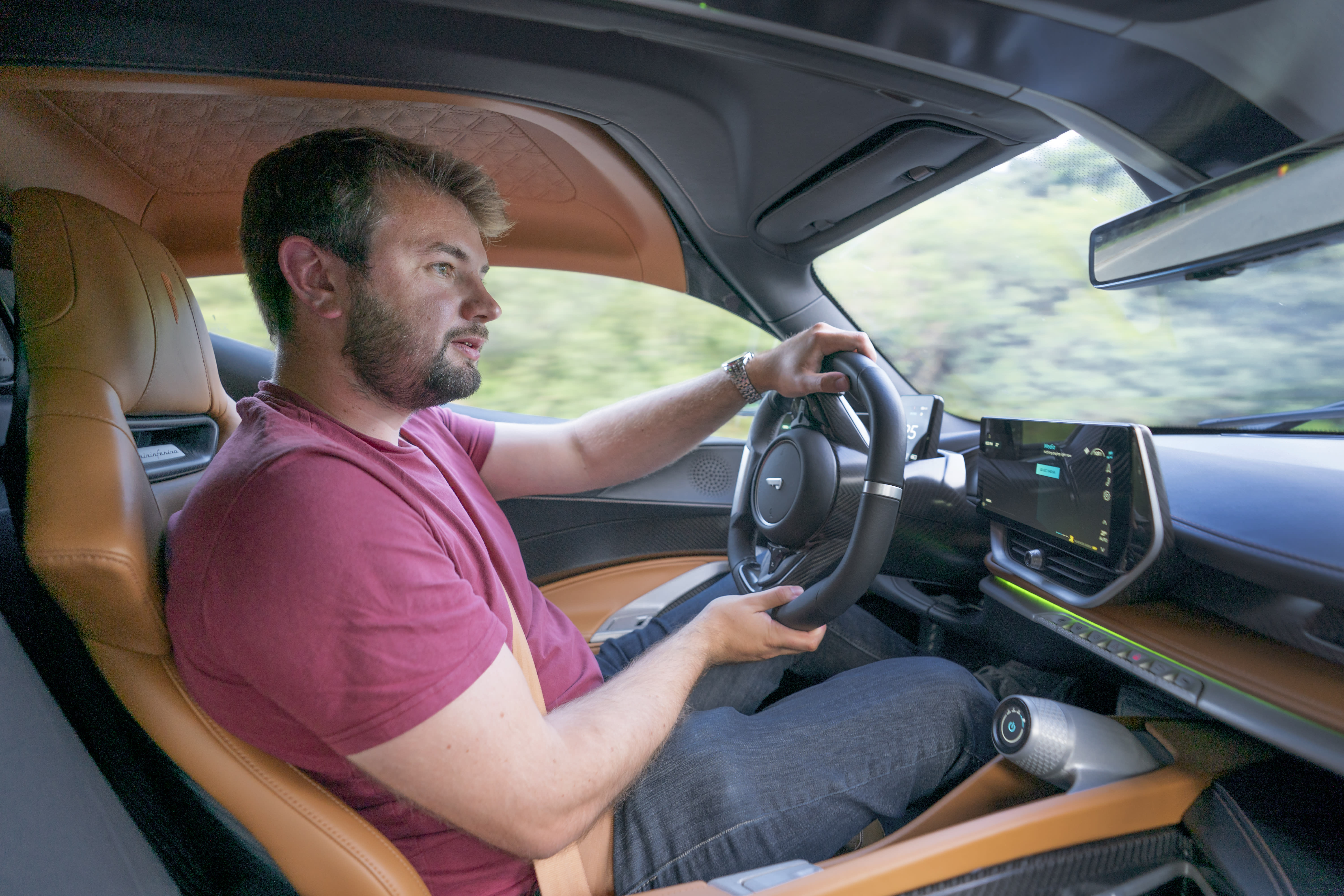
Inside, it’s similarly futuristic, with a cool dashboard design that feels as though it came from a spaceship, while a deluge of screens and displays maintain the ultra-modern feel. It’s well made, though, and while the style may not be to everyone’s tastes, the materials feel premium and there’s a sporty side to it.
Even so, it’s reasonably practical, with ample space for four adults and decent luggage capacity, while the aerodynamics give it respectable range, too. Combine that with some fairly powerful electric motors and decent handling for something so big and heavy, and you’re left with a car that feels sportier than the Skoda Enyaq and VW ID.5 with which it shares so much.
While it’s true there’s a bit of firmness to the ride, that’s in keeping with the sporty style, and it’s hardly an uncomfortable thing. On a long drive, it’s absolutely fine, thanks in part to its relaxing refinement and its supportive seats, but it might get a bit wearing if you just drive around town most of the time, because that’s where the ride is at its most wooden.

Key Features
For many, the deciding factor in choosing the Tavascan over its rivals is the styling, and while the design might be a little divisive, it’s certainly distinctive. The triangular motif in the headlights, the illuminated badges at both ends and the lashings of bronze all fit into the “Marmite” category, but they definitely set the car apart from its more conventional siblings in the Volkswagen Group stable. Similarly, the interior design, with that central pillar, might look a bit odd to some customers, but it suits the car’s exterior design and its whole attitude.
Then there are the electric powertrains. Even basic Tavascan models get motors and battery packs that would be considered mid-range in the ID.5 and Enyaq line-ups, with a 77kWh battery fitted to all Cupra Tavascans as standard. You can then choose whether you want to pair that battery with a single 286hp electric motor that drives the rear wheels, or two electric motors that provide all-wheel drive and 340hp. Naturally, the former offers more range, while the latter offers better performance.

Range & Batteries
Every version of the Tavascan comes with the same 77kWh battery, but the range available from that power pack depends on which motor option you pick. Opt for the ‘basic’ 286hp versions and the official WLTP economy test common to all new electric cars suggests a range of 353 miles. Whether you’ll achieve that in the real world is another matter, but that motor is reasonably efficient, and something in the region of 250 miles should be manageable, even on the motorway, where electric motors tend to be at their least efficient. Stick to slower roads and you could conceivably get closer to 300, though.
If, however, you go for the 340hp, all-wheel-drive powertrain, the official range figure drops to 320 miles. Again, you won’t manage that kind of range on the motorway – expect to see around 225 in those conditions – but you might get closer to 250 or 275 on a mixture of different roads. Find out more about EV range in our complete guide to electric car range.

Performance & Drive
Although every Tavascan gets the same 77kWh battery, not every Tavascan gets the same electric motor set-up. The base models use a 286hp motor to drive the rear wheels alone, and for most customers, that will be the most appealing choice. Not only does it provide more range than the twin-motor, all-wheel-drive version, but the 0-62mph time of 6.8 seconds will be more than ample for most.
Those that want more – or just want the security of all-wheel-drive – can choose the 340hp twin-motor version, however, bringing the 0-62mph time down to a punchy 5.5 seconds. That’s pretty quick, and it feels it, with lots of power available for overtaking and instant responses from the electric motors. It delivers the power securely, too, splitting it between the two axles to reduce the chances of wheelspin.
All told, though, the Tavascan feels pretty planted in both guises, with a well-sorted chassis that feels stable and provides a surprising amount of driver engagement for a family SUV. The battery under the floor means there isn’t too much body roll anyway, but the car’s suspension ensures the body stays nice and flat in the corners – unless you really, really push it, that is.
The catch is that the Tavascan is a bit firm at urban speeds, with the bumps transmitted into your backside through the seat and the sizeable alloy wheels. It improves at motorway speeds, when the car settles down a bit, but it’s still a bit firm. For a much smoother experience, you’ll want the adaptive dampers that provide a bit more bandwidth.
Either way, the Tavascan drives quite neatly, and it’s good fun on a country lane, while also being an amiable companion on longer motorway drives. It’s refined and punchy, but its sole vice is the brakes, which have an irritatingly inconsistent feel. They aren’t as bad as those in the latest Skoda Enyaq, but the need to combine regenerative braking with more conventional braking force creates a strange feeling in the pedal that doesn’t always inspire confidence.

Charging
No matter which motor combination you choose, the Tavascan gets the same maximum DC charging speed of 135kW, which is apparently enough to fill the battery from 10% to 80% in around half an hour or so. But to do that, you’ll need a suitably powerful charging point – in essence, we’re talking 150kW or more – to take advantage of that capability. At home, with a conventional domestic ‘wallbox’ home charging unit, you’ll probably spend all night filling the battery from empty. But with a real-world range of 200-plus miles, you shouldn’t need to fill from empty very often. Either way, if you plug it in when you get home from work, the car should be ready to go with a full charge – or at least almost a full charge – when you leave in the morning.
Want to know more about charging an EV? Be sure to check out our guide to charging an electric car.

Running Costs & Emissions
The key draw of electric vehicles – at least to private customers – is the running costs, and the Tavascan delivers as ably as any other EV on that front. While it may not be the most efficient electric car out there, it’s on a par with its rivals, and those who can take advantage of cheap-rate electricity will be able to charge at home at very little expense. Sure, the battery may not go as far as a tank of petrol, but it will be cheaper to fill. Even at a public charge point, it won’t be too ruinous, but the price advantage over petrol engines is somewhat diminished if you use rapid chargers all the time. Better, then, to install a ‘wallbox’ charge point at home.
For company car drivers, meanwhile, the advantage is purely a matter of taxation. Although electric vehicles incur more Benefit-in-Kind (BIK) tax than they once did, they are still much cheaper than petrol-powered vehicles, making a good EV like the Tavascan a very compelling choice.

Interior & Technology
Unlike its closely related rivals, which tend to be quite bland inside, the Tavascan has a striking dashboard design that really sets it apart. Viewed from the central rear seat, the dashboard resembles a bird of prey, with curved air vents arcing up to the windscreen pillars, while the distinctive central column between the centre console and the main dashboard resembles a kind of beak.
While the design may have some resemblance to prehistoric creatures, the effect is thoroughly modern. The dash is well appointed and clean in its design, but it’s also very well made, with lots of solid materials and impressive fit and finish that can easily rival that of supposedly more premium models.

Combine that with the sporty bucket seats and you’ve got a car that manages to feel sharper and more intentful than pretty much anything else in its class – at least from an interior design point of view.
And it hasn’t sacrificed technology to achieve that, either. There’s a massive central touchscreen with really cool graphics and rapid responses, while the smaller and more functional digital instrument cluster works in tandem with the head-up display projected onto the windscreen.
Admittedly, there are some issues with ergonomics – the touch-sensitive sliders under the touchscreen are next door to useless, and accessing heater controls through the touchscreen is pretty distracting when you’re on the move. But at least the displays respond sharply to your inputs and there is plenty of functionality there, which should keep tech-engrossed customers happy.

Practicality & Boot Space
As an unapologetic coupe-SUV, the Tavascan is slightly more interested in style, aerodynamics and sportiness than practicality. Yet it’s a big car, and it’s still a very roomy one. Four adults can sit inside in perfect comfort, with only the remarkably tall struggling for headroom in the rear. Legroom is more than adequate, too. Those in the front also have plenty of space and lots of adjustment in the seat, which makes life more comfortable on the road.
Further back, the boot is easy to access and not too high off the ground, although it’s naturally still higher than that of the smaller Cupra Born hatchback. The total boot space measures 540 litres, which is fractionally less than you’ll get from a Skoda Enyaq Coupe and VW ID.5, but the difference is hardly gigantic. And you can always fold the rear seats down and load to the roof if you really need to carry more cargo or simply something bulkier. As fastbacks go, then, the Tavascan is pretty practical.

Safety
The Tavascan has earned itself a strong five-star crash-test rating from the European independent safety organisation, Euro NCAP. With solid scores across the board, it’s as robust and as safe as anything else in its class, achieving around 80% or more in pretty much every area of the test. It gets good safety tech to prevent accidents from happening, too, with lane-keeping assistance, forward collision warning technology and drowsiness assistance tech all thrown in as standard. It gets Isofix child seat mounting points on the outermost rear seats and the front passenger seat, too, along with a rear-view camera and parking assistance technology.

Options
The Tavascan range comprises four different trim levels, although they are split down the middle, with two available for the ‘basic’ 286hp models and two for the 340hp versions.
For those 286hp cars, the V1 model is the entry point, offering 19-inch alloy wheels, keyless entry and cloth-covered bucket seats. Three-zone climate control, a reversing camera and automatic lights and wipers are also thrown in as standard, along with a heated steering wheel, wireless phone charging and an electrically operated tailgate.
Moving up to the more lavishly equipped V2 model, meanwhile, gets you larger 21-inch alloy wheels, a panoramic sunroof and Sennheiser premium audio system, as well as upgraded headlights and heated front seats.

Alternatively, those who choose the 340hp powertrain get the VZ1 model as standard, matching the V2’s 21-inch alloy wheels and Sennheiser audio system, while matching the heated seats, heated steering wheel and three-zone climate control. It gets bucket seats in dark microfibre upholstery, too, as well as the panoramic glass roof.
Finally, the range is crowned by the VZ2, which adds performance tyres and heated and ventilated Cup bucket seats in grey leather upholstery.
The options list isn’t especially long, with only a handful of colours available: a kind of beige standard colour called Atacama Desert, Tavascan Blue and grey and silver colour options. The only option pack, meanwhile, is the Winter pack offered on all but the basic V1 model, offering a more efficient heat pump, front and rear seat heating and a heated windscreen, which is well worth having.

Rival Cars
Naturally, the Tavascan will immediately be compared with the cars with which it shares so much. Perhaps the best known of these is the Volkswagen ID.5, which is a slightly more curvaceous take on the same underpinnings and offers great range, but it rides stiffly and doesn’t handle as well as the Cupra.
Similarly, the Enyaq is almost as enjoyable to drive – and is arguably the thinking person’s choice in this class – but feels a little more bland than the Cupra. As does the Audi Q4 Sportback e-tron, although nobody is calling that a boring car. It’s more high-tech than the Cupra, and it has some nicer materials in the cabin, but it isn’t as fun to drive as the Skoda or the Tavascan.
The other notable close relative of the Tavascan is the Ford Capri, which doesn’t live up to its famous name, but does have a cool, high-tech interior and a smart design. But it still doesn’t have the driving experience of the Tavascan.
Elsewhere, the Tavascan is up against the new Tesla Model Y, which is a vastly superior car to its predecessor, but still has plenty of idiosyncrasies, and the Kia EV6, which isn’t as roomy or as high-riding as the Cupra, but is just as exciting.
Verdict & Next Steps
Although the Tavascan is theoretically sportier than the ID.5 with which it shares so much, the Cupra will appeal to more than just the keen drivers. Yes, it’s more entertaining to steer than a Q4 e-tron, but it’s also more interesting to look at both inside and out. And while the design won’t suit everyone, those who want to stand out a bit will appreciate the edgier shape, which means the Cupra is deserving of its place in the electric coupe-SUV market. And for a surprisingly large number, it’ll actually be the best choice.
Where to next?
View latest CUPRA Tavascan lease deals - from just £325.97 per month inc VAT**.
Call us on 0118 3048 688 or hit the green 'Enquire' button for more details.
Looking for a great leasing deal? Check out our incredible range of Special Offers and Lease Deals.
New mid size SUV? Read our latest Reviews and find the right model for you.
Want to know more about leasing? Take a look at our comprehensive Leasing Guides.
Interested in everything motoring? Why not catch up on all the latest Car Leasing News.
**Score based on Select’s unique meta score analysis, taking into account the UK’s top leading independent car website reviews of the CUPRA Tavascan
**Correct as of 25/07/2025. Based on 9 months initial payment, 5,000 miles annually, over a 24month lease. Initial payment equivalent to 9 monthly payments, or £2,933.73 (Plus admin fee) Ts and Cs apply. Credit is subject to status.